
A solar-powered cellular trail camera can make remote scouting easier by reducing battery changes while sending photos and videos directly to your phone. The best cellular trail camera with solar panel should combine reliable 4G connectivity, fast trigger speed, clear day and night images, weather resistance, and efficient solar charging. These cameras are especially useful for hunting land, farms, wildlife monitoring, and remote property surveillance. In this guide, we review eight dependable models designed to deliver longer field operation, convenient app access, and practical performance in outdoor conditions.
1. SPYPOINT FLEX-M Solar Cellular Trail Camera Bundle
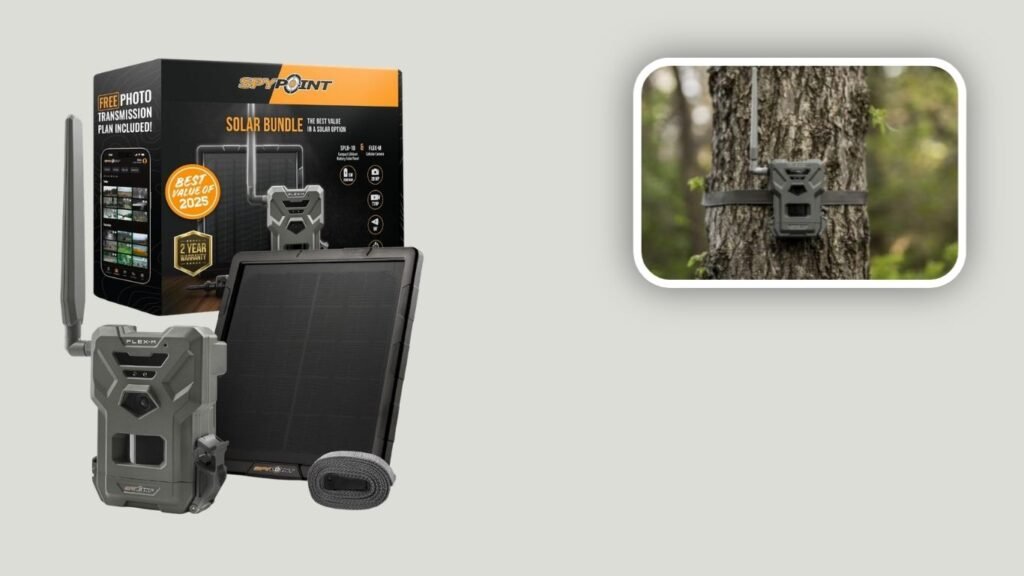
The SPYPOINT FLEX-M Solar Bundle combines a cellular trail camera with the SPLB-10 lithium battery solar pack, creating a practical setup for hunters who want fewer battery-changing trips. The FLEX-M uses dual-SIM multi-network connectivity and supports photos, video, Time-Lapse, and Time-Lapse+ capture modes. SPYPOINT lists 28MP photos, 720p video, a 0.4-second trigger speed, and approximately 90-foot detection and flash ranges for the FLEX-M platform.
Key Features
- 28MP photo resolution
- 720p video with sound
- 0.4-second trigger speed
- Approximately 90-foot detection range
- Dual-SIM multi-network connectivity
- SPLB-10 solar battery pack included
- Photo, video, Time-Lapse, and Time-Lapse+ modes
- GPS-enabled cellular monitoring
- Constant Capture technology
- 100 free photo transmissions per month
Why It Is Best for Long-Term Solar Scouting
The biggest attraction is the combination of cellular monitoring and dedicated solar power. Trail cameras positioned deep on hunting property can be inconvenient to reach, and every battery-changing visit can introduce unnecessary human activity.
The included solar battery pack helps reduce those trips while keeping the camera ready for extended deployments. Dual-SIM technology is equally useful because the camera is designed to select suitable coverage across supported cellular networks rather than locking the user into one carrier.
Detection and Remote Monitoring Performance
A 0.4-second trigger is responsive enough for deer trails, feeder areas, crossings, and other active locations. The approximately 90-foot detection range provides useful coverage without requiring animals to pass extremely close to the camera.
Constant Capture is another practical feature because the camera can continue capturing while transmitting previous images. Time-Lapse+ combines scheduled photography with motion-triggered captures, making it useful for larger food plots or open fields.
Best Use and Overall Verdict
The SPYPOINT FLEX-M Solar Bundle fits hunters who want an established cellular platform combined with renewable field power.
Its mix of automatic network connectivity, multiple capture modes, app-based monitoring, and solar-supported operation makes it especially suitable for season-long scouting. For remote locations where minimizing maintenance visits is a priority, the included solar pack adds meaningful practical value.
2. MagicEagle EagleCam 5 Cellular Trail Camera With Solar Panel
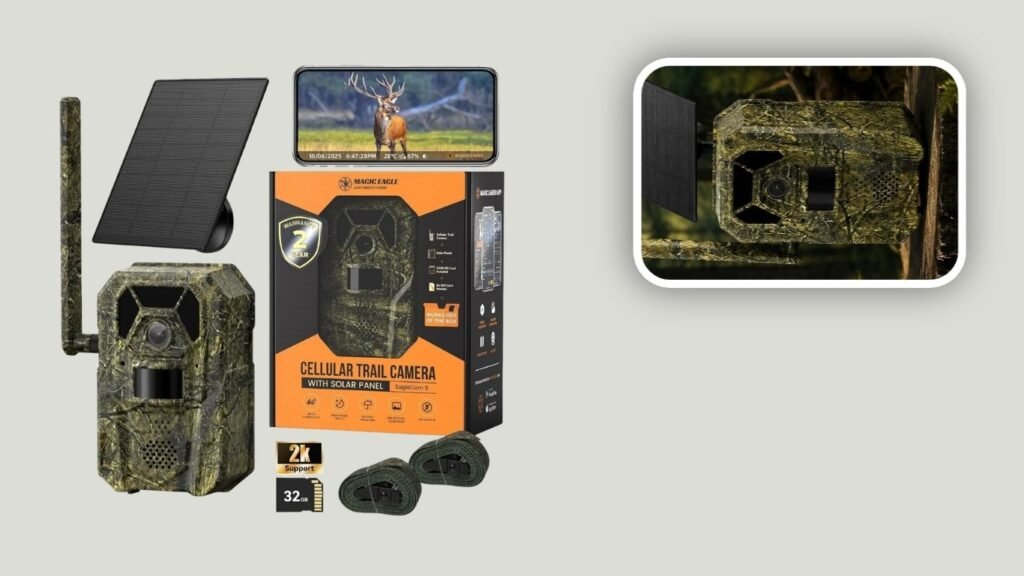
The MagicEagle EagleCam 5 combines 4G cellular monitoring with a substantial 13,000mAh rechargeable battery and an included solar panel. It also offers no-glow infrared night vision, GPS tracking, live viewing, audio, IP66 weather resistance, and 2K video recording. The camera’s SignalSync system is designed to automatically connect through available supported networks without requiring users to install a separate SIM card.
Key Features
- 13,000mAh rechargeable battery
- Solar panel included
- 4G cellular connectivity
- SignalSync automatic network switching
- 2K video recording
- No-glow infrared night vision
- GPS location tracking
- Live view and playback
- IP66 waterproof rating
- 108-degree field of view
- 32GB SD card included
Why It Is Best for High-Capacity Solar Power
Battery capacity is one of the EagleCam 5’s strongest characteristics. A 13,000mAh built-in rechargeable battery provides a substantial reserve when sunlight is limited, while the solar panel can replenish power during normal outdoor deployment.
This arrangement is particularly attractive for remote land where regular battery replacement would be inconvenient. Hunters can position the camera farther from frequently traveled areas while still maintaining access through the mobile app.
Night Vision and Smart Monitoring Performance
No-glow infrared illumination is useful for locations where discreet nighttime operation matters. The infrared system is designed to capture activity without producing a visible flash that could draw attention around the camera.
The EagleCam 5 also supports live view, audio, GPS, and wildlife-identification features. Its GPS capability is particularly interesting for expensive equipment left unattended in remote environments because the camera can report its location through the connected platform.
Best Use and Overall Verdict
The EagleCam 5 is well suited to hunters, wildlife watchers, farm owners, and remote property managers who want a solar cellular camera with a large integrated battery.
Its combination of rechargeable power, solar charging, GPS, no-glow night vision, IP66 protection, and live app access creates a more complete remote-monitoring system than a basic trail camera. It is especially appealing where long deployment periods and reduced maintenance are important.
3. Moultrie EDGE 3 Cellular Trail Camera With 3.4W Solar Kit
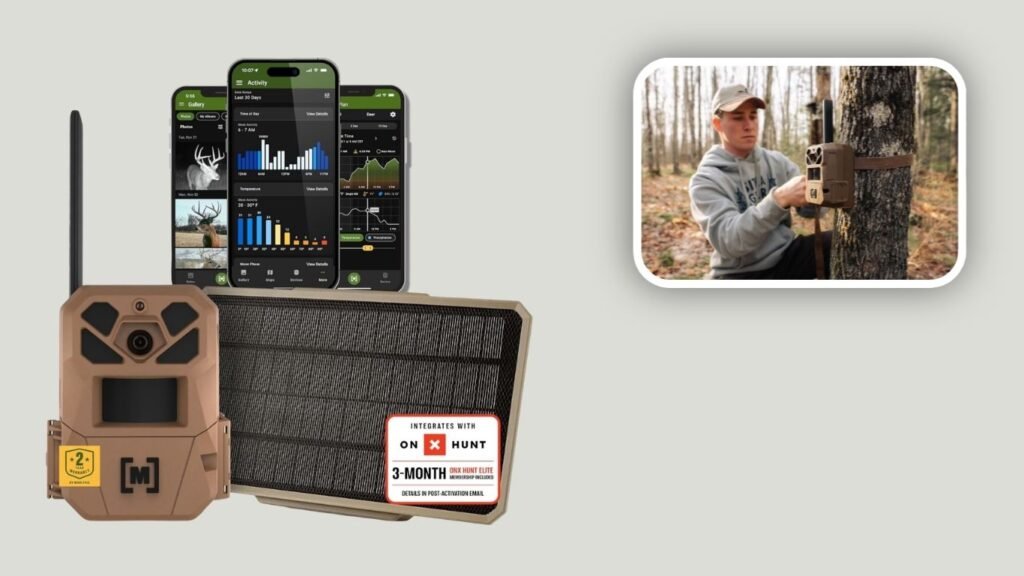
The Moultrie EDGE 3 Solar Kit combines the EDGE 3 cellular camera with Moultrie’s 3.4W Solar Power Pack. The camera captures 40MP images and 1080p FHD video while offering a 0.5-second trigger speed, 100-foot detection and flash ranges, GPS, built-in memory, Live Aim, and automatic multi-carrier connectivity. The solar pack includes its own internal power bank, reducing dependence on disposable AA batteries.
Key Features
- 40MP photo resolution
- 1080p FHD video
- 0.5-second trigger speed
- 100-foot detection range
- 100-foot low-glow flash range
- 3.4W solar power pack included
- Built-in camera memory
- Automatic multi-carrier cellular connection
- GPS and Live Aim
- Moultrie AI detection
- On-demand photos and videos
Why It Is Best for Smart Deer Scouting
The EDGE 3 is particularly focused on hunting intelligence rather than simple image capture. Moultrie AI can identify buck activity and help prioritize relevant captures, while the app provides remote access to images, settings, and camera locations.
Built-in memory also removes one commonly forgotten accessory: the SD card. This simplifies initial setup and reduces the chance of reaching the field only to discover that storage was left behind.
Solar Power and Detection Performance
The included solar pack contains a 3,350mAh internal power bank and is designed to keep the EDGE system replenished during field use. Moultrie lists IP65 weather resistance for the solar unit and provides power reporting through compatible EDGE cameras.
The 100-foot detection range is valuable around food plots, field edges, and wide trails, while a 0.5-second trigger gives the camera a reasonable response window for moving wildlife.
Live Aim can also simplify placement by showing the camera’s view through the app during installation.
Best Use and Overall Verdict
This Moultrie bundle is particularly appropriate for deer hunters who want app-based intelligence, dependable image quality, and reduced battery maintenance.
The solar pack complements the EDGE 3’s remote capabilities well because it helps minimize physical visits to the camera. Combined with GPS, automatic network selection, 40MP images, and built-in storage, it forms a strong season-long scouting setup.
4. SEHMUA 4G LTE Cellular Trail Camera With Solar Panel
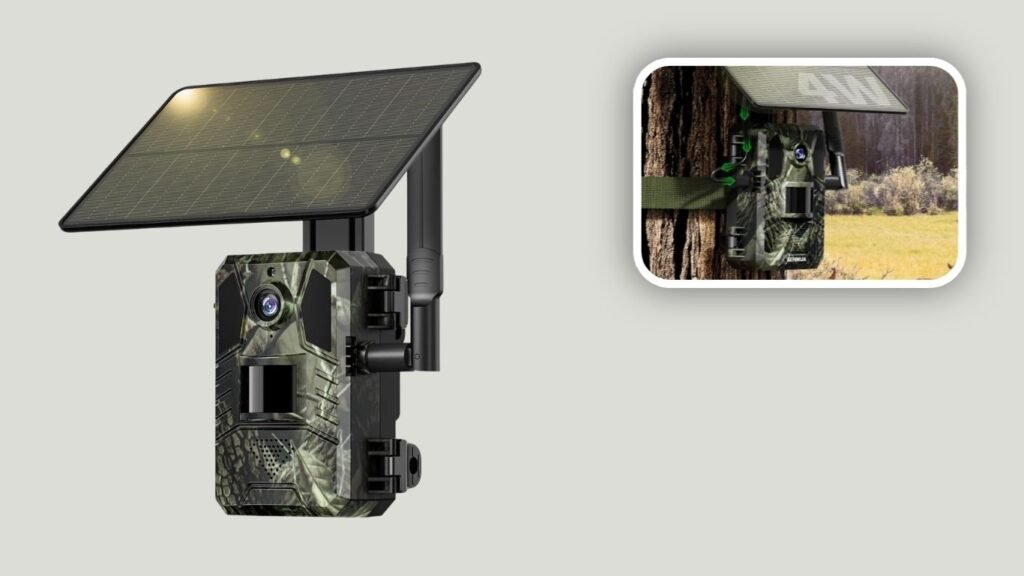
The SEHMUA 4G LTE Cellular Trail Camera combines live remote viewing with a built-in 7,800mAh rechargeable battery and a 4W solar panel. It records up to 2K video, offers a fast 0.2-second trigger speed, and provides approximately 82 feet of infrared night vision. Its 120-degree viewing angle and IP66-rated housing make it suitable for wildlife, farm, and remote property monitoring.
Key Features
- 4G LTE cellular connection
- 2K video resolution
- 0.2-second trigger speed
- 7,800mAh rechargeable battery
- 4W solar panel
- Up to 82-foot night vision
- 120-degree viewing angle
- IP66 waterproof rating
- Live smartphone viewing
- App-based controls and alerts
- Supports local and cloud storage
Why It Is Best for Live Solar Monitoring
Unlike cellular cameras focused mainly on transmitting individual photos, the SEHMUA emphasizes remote live access. That can be particularly valuable for monitoring a feeder, farm entrance, livestock area, or hunting location where users want to check current conditions.
The solar panel and large rechargeable battery complement live-monitoring features because cellular streaming can demand more power than occasional photo transmission.
Motion Detection and Night Performance
The listed 0.2-second trigger speed is one of this model’s stronger technical specifications. A quick trigger improves the chance that fast-moving animals remain centered in the captured footage rather than leaving the frame before recording begins.
An approximately 82-foot night-vision range provides useful coverage after dark, while the 120-degree viewing angle captures a comparatively broad section of the scene.
Its IP66 rating is another meaningful feature for equipment expected to stay outdoors through rain, dust, and changing seasonal conditions.
Best Use and Overall Verdict
The SEHMUA is particularly suitable for users who prioritize live viewing and rapid alerts alongside traditional trail-camera functions.
Solar charging and the 7,800mAh battery reduce the maintenance demands of a cellular device, while 2K video and wide coverage add useful visual detail. For hunting land, farms, gates, or remote property where real-time access matters, its feature combination is technically attractive.
5. Misstech 4G LTE Cellular Trail Camera With Solar Panel
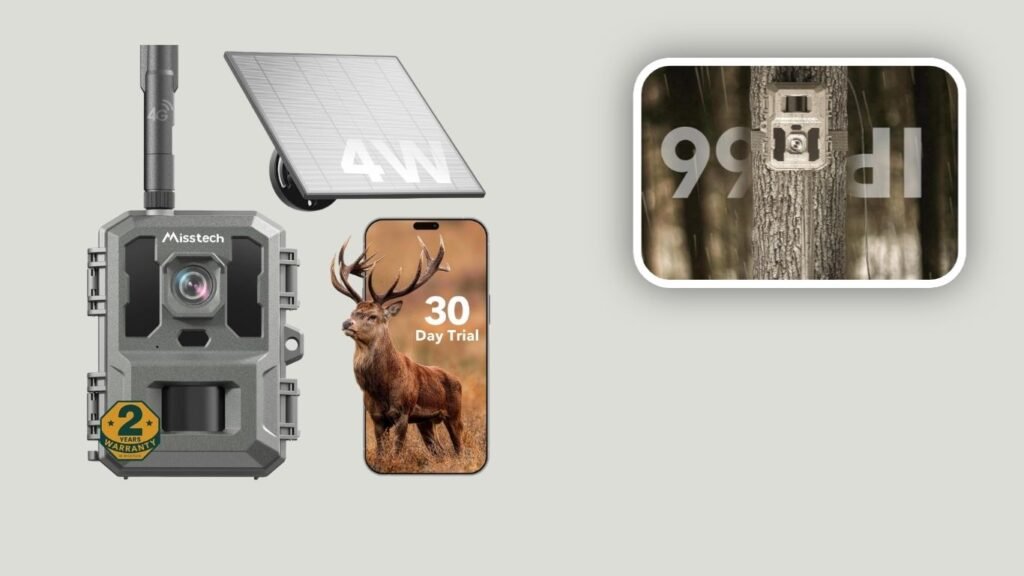
The Misstech cellular trail camera is designed around fast remote monitoring, combining 4G LTE connectivity, solar-supported power, app notifications, and live viewing. Available product information for the cellular model describes 2K live streaming, an approximately 0.1-second motion response, a 4W solar panel, and 940nm no-glow infrared illumination. These features make it particularly interesting for monitoring active wildlife trails and remote property where quick notifications are useful.
Key Features
- 4G LTE cellular connectivity
- 2K live-view capability
- Approximately 0.1-second motion detection
- 4W solar panel
- Smartphone activity alerts
- 940nm no-glow infrared night vision
- Remote app viewing
- Motion-activated recording
- Designed for outdoor wildlife monitoring
- Solar-supported rechargeable operation
Why It Is Best for Fast Cellular Alerts
A trail camera can have excellent image quality but still miss useful activity if its response is too slow. The Misstech’s listed 0.1-second motion detection gives it a significant focus on quick activation.
That speed is particularly relevant on narrow game trails where deer may move across the detection zone quickly. Fast notifications can also be valuable when the camera is being used around farms, remote entrances, or other areas where users want timely awareness.
Solar Power and Night Monitoring Performance
The 4W solar panel supports longer off-grid operation and can reduce how frequently the camera needs physical charging. This matters even more on a cellular camera because live streaming and network communication can place greater demands on the battery than conventional SD-card-only trail cameras.
Its 940nm no-glow infrared system is intended to keep nighttime illumination discreet. Because the infrared LEDs do not create an obvious visible glow, the camera can monitor wildlife after dark while minimizing visual disturbance around the installation point.
Best Use and Overall Verdict
The Misstech makes the most sense for users who value fast alerts, solar charging, and live app access.
Its 0.1-second listed detection response stands out for monitoring moving animals, while 2K live viewing provides more immediate information than standard photo-only transmission. For feeders, farms, wildlife trails, and remote land where both rapid detection and reduced battery maintenance matter, this cellular solar configuration offers a useful combination of features.
6. GLEEMALL 4G LTE Cellular Solar Trail Camera 2-Pack
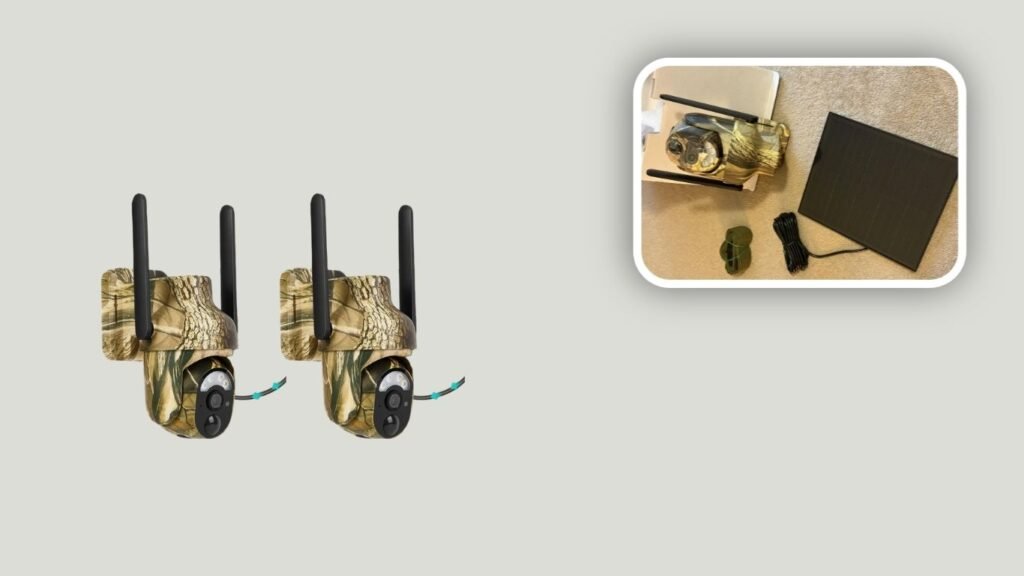
The GLEEMALL 4G LTE Cellular Trail Camera package offers two solar-powered cameras designed for remote wildlife and property monitoring without relying on Wi-Fi. Each camera supports 2K video, cellular connectivity through a built-in SIM system, app-based remote access, and 360-degree live viewing. Solar-assisted power makes the package particularly practical for hunters who want to monitor two distant locations while reducing battery-maintenance trips.
Key Features
- Two cellular trail cameras included
- 4G LTE cellular connectivity
- Built-in SIM connectivity
- Solar and rechargeable battery power
- 2K video resolution
- 360-degree live viewing
- Remote smartphone access
- Motion-activated recording
- Night-vision capability
- IP65 weather-resistant construction
- No Wi-Fi connection required
Why It Is Best for Wide-Area Remote Monitoring
The two-camera format immediately gives this package an advantage for larger hunting properties. Instead of relying on a single viewpoint, hunters can monitor two trails, feeders, field entrances, or other locations simultaneously.
Its 360-degree viewing capability also provides more flexibility than a conventional fixed-angle trail camera. Through remote controls, users can examine a wider section of the surroundings rather than being restricted entirely to the original mounting direction.
Because cellular connectivity replaces the need for local Wi-Fi, the cameras can be positioned in wooded or remote locations as long as compatible cellular coverage is available.
Solar Power and Live-View Performance
Solar-assisted charging helps support extended field operation while reducing reliance on repeated manual battery changes. That is particularly valuable for a two-camera setup because maintaining multiple remote cameras can otherwise require considerably more travel.
The 2K live-view system gives users the ability to check current conditions through a compatible smartphone app. Motion activation provides automatic recording when wildlife enters the monitored area, while nighttime functionality extends monitoring beyond daylight hours.
Best Use and Overall Verdict
This package works especially well for hunters and property owners who need broader coverage from two remote monitoring points.
Its combination of cellular access, solar-supported operation, 2K video, app controls, and wide viewing makes it more versatile than a conventional photo-only trail camera. For monitoring large properties while minimizing routine camera checks, the twin-camera configuration provides substantial practical value.
7. CEYOMUR Solar WiFi Trail Camera
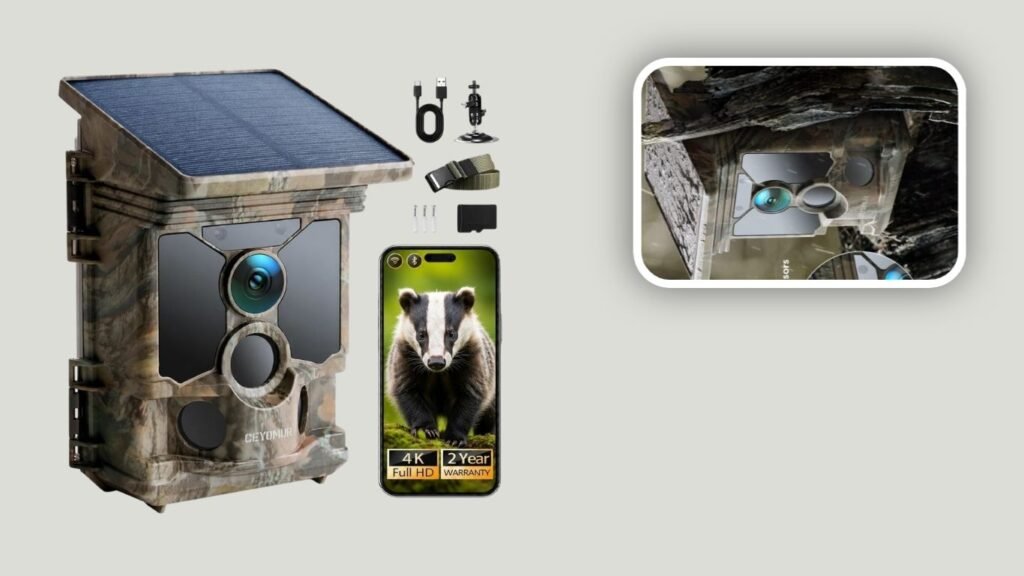
The CEYOMUR Solar Trail Camera combines an integrated solar panel with a rechargeable battery, high-resolution imaging, Bluetooth, Wi-Fi connectivity, and motion-triggered wildlife recording. One important distinction is that the exact B09Y8V268F model is a local Wi-Fi/Bluetooth trail camera rather than a true cellular trail camera. It therefore suits users who want solar power and smartphone access but do not require long-distance photo transmission through a cellular network.
Key Features
- Built-in solar charging system
- Rechargeable internal battery
- High-resolution wildlife photography
- 4K video capability
- 0.1-second listed trigger speed
- 120-degree detection coverage
- Wi-Fi and Bluetooth connectivity
- Smartphone app controls
- IP66 weather-resistant housing
- Infrared night vision
- Local wireless image transfer
Why It Is Best for No-Subscription Local Monitoring
The biggest advantage of this CEYOMUR model is that it does not depend on a cellular data plan. Instead, Bluetooth helps discover the camera and its built-in Wi-Fi connection transfers images, videos, and settings directly to a nearby smartphone.
This makes it attractive for backyard wildlife observation, farms, private woodland, or hunting locations that users can approach periodically.
Its solar panel and rechargeable battery also reduce dependence on disposable batteries, allowing the camera to remain positioned outdoors for longer periods with less routine power maintenance.
Image Quality and Motion Detection
CEYOMUR lists fast motion triggering, broad PIR coverage, and high-resolution photo and video recording for this model. The wide detection area can help capture animals approaching from different directions instead of requiring them to travel directly in front of the lens.
Bluetooth and Wi-Fi also make checking camera alignment and downloading footage easier when standing within wireless range. However, the official product information states that this connection is local rather than internet-based, so remote access from miles away is not available.
Best Use and Overall Verdict
The CEYOMUR makes sense for buyers whose priority is solar power and convenient local smartphone access rather than cellular transmission.
It is particularly suitable for gardens, nearby hunting properties, farms, and wildlife-monitoring locations that can be visited occasionally. Its combination of solar charging, fast motion detection, high-resolution recording, and app connectivity provides strong functionality without recurring cellular data costs.
8. Cellular Trail Camera With Solar Panel and GPS Tracking
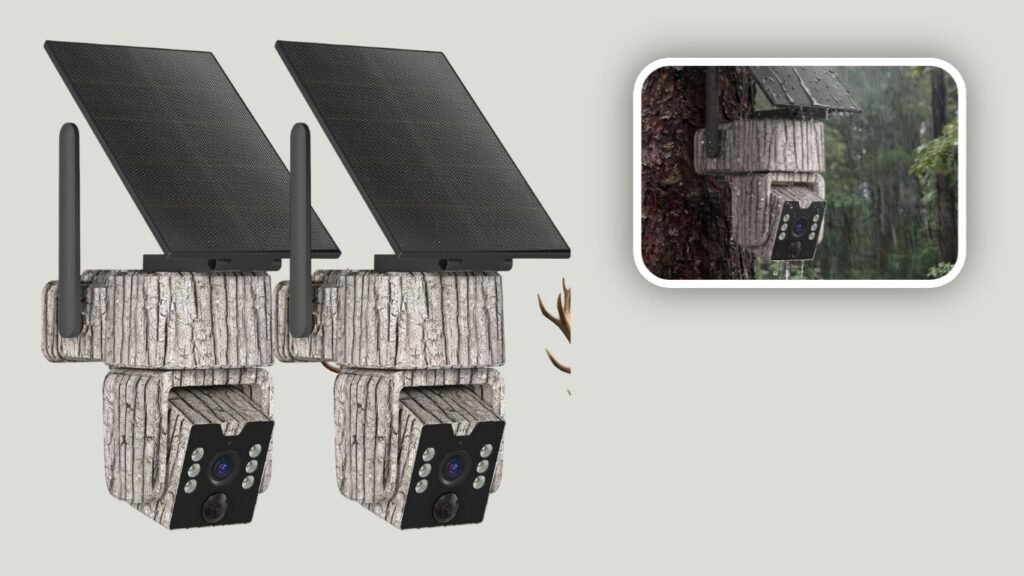
This cellular trail camera is aimed at users who want an all-in-one remote monitoring system for hunting, wildlife observation, and outdoor property surveillance. The listing emphasizes cellular operation, tracking capability, outdoor use, and a ready-to-deploy connectivity setup. Combined with solar-supported operation, this type of design is particularly useful where regular battery changes and frequent physical camera checks would be inconvenient.
Key Features
- Cellular remote connectivity
- Solar-supported outdoor operation
- Tracking functionality
- Preinstalled connectivity setup
- Smartphone remote monitoring
- Motion-activated operation
- Suitable for hunting and wildlife monitoring
- Designed for remote outdoor placement
- Reduced need for routine battery replacement
- Remote access without local Wi-Fi
Why It Is Best for Remote Camera Management
A camera placed several miles from home becomes much more useful when users do not need to drive to the site simply to determine whether animals have passed through.
Cellular connectivity allows captured activity to be accessed remotely through a compatible mobile platform, while tracking functionality can provide additional reassurance when equipment is left unattended in distant areas.
A preconfigured connectivity system can also simplify the initial setup process compared with cameras that require users to select, purchase, and manually install a separate SIM card.
Solar Power and Field Convenience
Solar power is particularly valuable for cellular trail cameras because transmitting information over a mobile network consumes additional energy. A solar-supported system can replenish the internal battery during daylight hours and help extend the period between maintenance visits.
This setup is especially useful on hunting leases, farms, cabins, food plots, and remote sections of large properties.
The combination of remote access and renewable charging also reduces the need to repeatedly enter wildlife areas, which can help hunters avoid introducing unnecessary scent and disturbance around frequently monitored trails.
Best Use and Overall Verdict
This type of solar cellular camera fits hunters who prioritize long-term remote access and easier power management.
Tracking, preconfigured connectivity, solar charging, and app-based monitoring provide a useful combination for equipment positioned away from convenient power or Wi-Fi sources. For users managing distant acreage, it can provide a more practical monitoring approach than conventional SD-card cameras that require frequent physical checks.
FAQs
1. Are Solar Cellular Trail Cameras Worth It?
Solar cellular trail cameras can be especially useful for remote locations because they address two common inconveniences at once. Cellular connectivity allows photos, alerts, or live footage to reach your phone, while solar charging can reduce how often batteries need to be replaced or manually recharged. They are particularly practical for hunting leases, farms, cabins, and distant wildlife-monitoring locations.
2. Do Cellular Trail Cameras With Solar Panels Need Batteries?
Most still use a rechargeable internal battery or battery pack. The solar panel does not normally power every function directly at all times; instead, it replenishes the battery during available sunlight. Some models may also support AA batteries as backup power. Battery capacity and solar-panel output should therefore be checked when comparing models.
3. Do Solar Cellular Trail Cameras Need Wi-Fi?
No. A true cellular trail camera uses a mobile network rather than a home Wi-Fi connection. As long as the installation location has compatible cellular coverage and an active data plan, the camera can transmit information remotely. Some products marketed as wireless trail cameras use only short-range Wi-Fi or Bluetooth, so checking whether the model specifically supports 4G LTE is important.
4. Do Cellular Trail Cameras Require a Monthly Fee?
Most cellular models require an active data plan for remote transmission or live-view features. Pricing depends on the manufacturer, data allowance, transmission volume, and subscription level. Some cameras include trial data or limited free transmissions, but ongoing cellular features commonly involve recurring costs. Local recording to an SD or memory card may continue even when cellular service is inactive.
5. What Is the Best Cellular Trail Camera With a Solar Panel for Hunting?
The right model depends on where and how it will be used. Look for dependable cellular coverage, efficient solar charging, sufficient battery capacity, fast trigger response, useful detection range, reliable night vision, weather resistance, and a well-designed mobile app. Hunters monitoring remote areas may also benefit from GPS, multi-carrier connectivity, live view, and cameras that include the solar panel rather than requiring it as a separate accessory.
