
North Dakota duck hunting offers access to prairie wetlands, large lakes, agricultural fields, rivers, and publicly accessible hunting areas. The state lies within the Prairie Pothole Region, an important breeding area that supports approximately half of North America’s breeding duck population. Hunters can pursue puddle ducks, diving ducks, mergansers, and coots during the fall migration. However, residents and nonresidents have different opening dates and licensing rules. Nonresident hunters must also select hunting zones and limit their trips to specific seven-day periods. Careful scouting, land-access research, correct bird identification, and current regulation checks are essential before every hunt.
North Dakota Duck Hunting Season 2026
North Dakota’s 2026 regular duck season opens on September 26 for residents and October 5 for nonresidents. Residents receive a nine-day period before nonresidents may begin hunting. The High Plains Unit also reopens for a late segment in December. These dates are listed as finalized by the North Dakota Game and Fish Department.
| Season or hunting group | Opening date | Closing date |
| Youth waterfowl season | September 19, 2026 | September 20, 2026 |
| Veteran and active military season | September 19, 2026 | September 20, 2026 |
| Resident Low Plains season | September 26, 2026 | December 6, 2026 |
| Resident High Plains season | September 26, 2026 | December 6, 2026 |
| Bonus blue-winged teal period | September 26, 2026 | October 4, 2026 |
| Nonresident Low Plains season | October 5, 2026 | December 6, 2026 |
| Nonresident High Plains season | October 5, 2026 | December 6, 2026 |
| Late High Plains season | December 12, 2026 | January 3, 2027 |
Season dates alone do not show species limits, shooting-hour exceptions, closed rest areas, or other restrictions. Hunters should review the complete 2026–27 guide immediately before traveling.
North Dakota Duck Hunting License Requirements
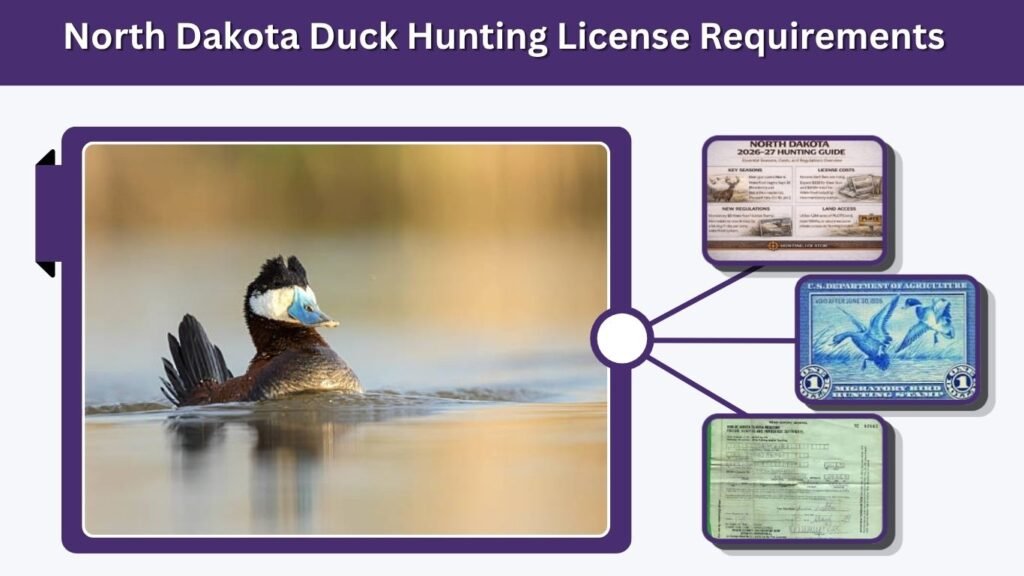
Every hunter must carry the licenses and registrations required for their age and residency status. Migratory-bird hunters must complete North Dakota Harvest Information Program registration annually.
Resident Requirements
A resident duck hunter generally needs:
- Fishing, Hunting and Furbearer Certificate
- General Game and Habitat License
- Small Game License or qualifying combination license
- North Dakota HIP registration
- Waterfowl Habitat Restoration Stamp
- Federal Duck Stamp when age 16 or older
Youth requirements may differ according to age, hunter-education status, and the season being hunted.
Nonresident Requirements and Cost
Nonresident hunters generally need the following:
| Requirement | Listed fee |
| Zone-restricted waterfowl license | $153 |
| Fishing, Hunting and Furbearer Certificate | $5 |
| General Game and Habitat License | $20 |
| Federal Duck Stamp | $29 |
| Waterfowl Habitat Restoration Stamp | $5 |
| HIP registration | Free |
These listed components total $212 for a nonresident hunter aged 16 or older. Other permits may be necessary for species such as tundra swans or sandhill cranes. Current fees and eligibility should be confirmed when purchasing the license.
Nonresident Duck Hunting Zones
North Dakota has six nonresident waterfowl zones:
- Northeast
- North-central
- Northwest
- Southeast
- South-central
- Southwest
A nonresident may hunt during two seven-day periods each year. The hunter must select a different zone for each period and cannot select the same zone twice. Someone planning only one seven-day trip may select two zones and run both periods concurrently, but doing so uses the entire annual regular-season allowance.
Choose zones carefully before buying the license. Consider lodging, public access, current water conditions, bird movements, and the distance between planned hunting areas. The official nonresident-zone map should be used instead of relying on county names alone.
Best Places to Hunt Ducks in North Dakota
North Dakota contains a mixture of small potholes, seasonal wetlands, large lakes, rivers, grain fields, and managed wildlife areas. Conditions can change significantly with drought, rainfall, crop harvest, and migration patterns.
Prairie Pothole Region
The Prairie Pothole Region covers much of central and eastern North Dakota. Its shallow wetlands provide breeding, resting, and feeding habitat for numerous waterfowl species. Hunters commonly explore areas containing clusters of wetlands surrounded by grassland and agricultural fields.
Devils Lake Area
Devils Lake and its surrounding wetlands are widely known for waterfowl hunting. The region can offer both over-water and field-hunting opportunities, but popularity may produce competition around easily accessible locations. Early scouting and legal access arrangements are important.
Missouri River Corridor
The Missouri River corridor and surrounding reservoirs can provide opportunities for ducks and geese, particularly as smaller wetlands freeze. Hunters must identify closed areas, waterfowl rest areas, refuges, and location-specific restrictions before setting up.
Public-Land Duck Hunting
The North Dakota Hunting Atlas displays Wildlife Management Areas, PLOTS properties, Waterfowl Production Areas, electronically posted private land, state trust land, and other potentially accessible properties. Rules vary by land manager, so appearing on the map does not automatically mean every location is open to duck hunting.
PLOTS Properties
Private Land Open To Sportsmen properties provide public walk-in hunting access during legal seasons unless signs state otherwise. Vehicles, camping, equipment storage, and other activities require landowner permission.
Nonresidents cannot hunt any game on Game and Fish Wildlife Management Areas or PLOTS properties during the first seven days of the pheasant season. This restriction can affect a planned duck hunt, so nonresidents should check overlapping dates before choosing access points.
Private Land
Private land may be open unless it is legally posted or otherwise restricted, but hunters must check both physical signs and electronic postings. Even where permission is not legally required, politely contacting the landowner can prevent confusion and improve future access. Entering posted land without permission can result in fines, criminal penalties, and loss of hunting privileges.
Best Time to Hunt Ducks in North Dakota
The best period depends on the species, weather, water levels, and hunting method.
Late September and Early October
Residents can hunt beginning September 26, while nonresidents begin October 5. Early hunting can provide opportunities for locally produced ducks and early migrants before freezing conditions reduce the number of available wetlands.
Mid-to-Late October
October is a popular period for mixed duck species. Cold fronts can bring new migrants, while harvested fields may concentrate feeding birds. Pressure can also move ducks away from heavily hunted public wetlands.
November and December
Late-season hunting may improve when cold weather pushes northern birds into North Dakota. However, frozen shallow wetlands may reduce available water. Larger lakes, rivers, and open-water areas become more important, and severe weather increases boating and exposure risks.
Migration timing is never guaranteed. Hunters should scout shortly before the hunt rather than relying only on reports published several days earlier.
Guided vs. DIY North Dakota Duck Hunting
A guided hunt may include local scouting, decoys, blinds, field access, dogs, and transportation within the hunting area. It can be helpful for first-time visitors who have limited time to locate birds and secure permission.
A do-it-yourself trip offers greater flexibility and may cost less, but it requires more preparation. DIY hunters should study the Hunting Atlas, contact landowners, monitor weather, check waterfowl reports, and prepare several backup locations. Never assume a wetland or harvested field will hold birds throughout the trip.
Important Duck Hunting Regulations
Duck hunters must follow both state and federal migratory-bird rules. Standard requirements include:
- Use approved nontoxic shot
- Use a shotgun no larger than 10 gauge
- Limit the shotgun to three shells unless an exception applies
- Never hunt over bait or a baited area
- Do not use live birds as decoys
- Do not use electronic or recorded calls for regular waterfowl hunting
- Make a reasonable effort to retrieve downed birds
- Keep required identifying feathers attached during transportation
- Know the daily and possession limits for each species
Waterfowl may be hunted from a floating craft, but a motorized craft must be stationary with its motor turned off before birds are taken.
Essential Equipment
North Dakota weather can change quickly during fall. A practical equipment list includes:
- Valid licenses, stamps, and HIP number
- Nontoxic ammunition
- Species-identification guide
- Waders and waterproof clothing
- Layered cold-weather clothing
- Duck calls and appropriate decoys
- Blind material suited to the surroundings
- Headlamp and backup batteries
- First-aid kit
- Offline maps and charged phone
- Personal flotation device for boat hunting
- Dry clothing stored in a waterproof bag
Boat hunters should avoid unfamiliar water during high winds, freezing conditions, or poor visibility. Wearing a flotation device is more important than reaching a particular hunting location.
FAQs
When will the North Dakota duck season open in 2026?
The regular season opens September 26, 2026, for residents and October 5 for nonresidents. Both Low Plains and High Plains seasons initially close December 6, while the High Plains Unit reopens from December 12 through January 3, 2027.
How long can nonresidents hunt ducks in North Dakota?
Nonresidents may hunt during two seven-day periods. Each period must normally be assigned to a different zone. A hunter taking only one trip may select two zones concurrently, but this uses both seven-day periods.
Is there public duck-hunting land in North Dakota?
Yes. Potential opportunities include Wildlife Management Areas, PLOTS properties, Waterfowl Production Areas, state lands, and other federally managed properties. Hunters must check the Hunting Atlas, entrance signs, closures, and land-manager regulations before hunting.
Is Devils Lake good for duck hunting?
The Devils Lake region is a well-known waterfowl destination with a large lake, surrounding wetlands, and nearby agricultural fields. Success still depends on migration, weather, access, scouting, and hunting pressure.
Do nonresidents need a federal Duck Stamp?
Yes. Nonresident duck hunters aged 16 or older need a federal Duck Stamp, along with the North Dakota waterfowl license, required certificates, HIP registration, and the state Waterfowl Habitat Restoration Stamp.
