
Arkansas duck hunting offers flooded hardwood timber, shallow rice fields, managed wetlands, and public wildlife areas along the Mississippi Flyway. Stuttgart is the best-known destination, but productive hunting opportunities extend across eastern and northeastern Arkansas. Hunters can arrange fully guided trips, lease private land, or pursue ducks independently on public areas. Before entering the field, however, every hunter should understand the current season dates, required licenses, shooting hours, bag limits, and property-specific regulations.
Why Is Arkansas Famous for Duck Hunting?
Arkansas attracts large numbers of migrating waterfowl because of its location within the Mississippi Flyway. Its combination of river bottoms, agricultural fields, reservoirs, wetlands, and flooded forests provides food and resting habitat for mallards, gadwalls, teal, pintails, wood ducks, and other species.
The uploaded search data highlights especially strong interest in Arkansas seasons, licenses, Stuttgart guides, public hunting land, flooded timber, lodges, and guided trips.
Flooded Timber Hunting
Flooded timber duck hunting is one of Arkansas’s signature experiences. Hunters stand beside large trees in shallow water while calling ducks through openings in the forest canopy.
Mallards may circle over the timber before dropping vertically into an opening known as a hole. This creates close-range shooting, but it also requires accurate calling, effective concealment, safe movement through water, and careful identification of birds.
Water depth and timber flooding vary according to rainfall, river levels, and water-management decisions. A historically productive area may have poor conditions during a dry season, so hunters should check current habitat and access reports before traveling.
Agricultural Field Hunting
Flooded rice, soybean, and corn fields can attract ducks searching for waste grain and shallow resting water. Field hunting commonly uses larger decoy spreads and permanent or portable blinds.
Fields may be more accessible than flooded forests, but success depends heavily on weather, migration activity, pressure, water availability, and land management.
Arkansas Duck Hunting Season Dates
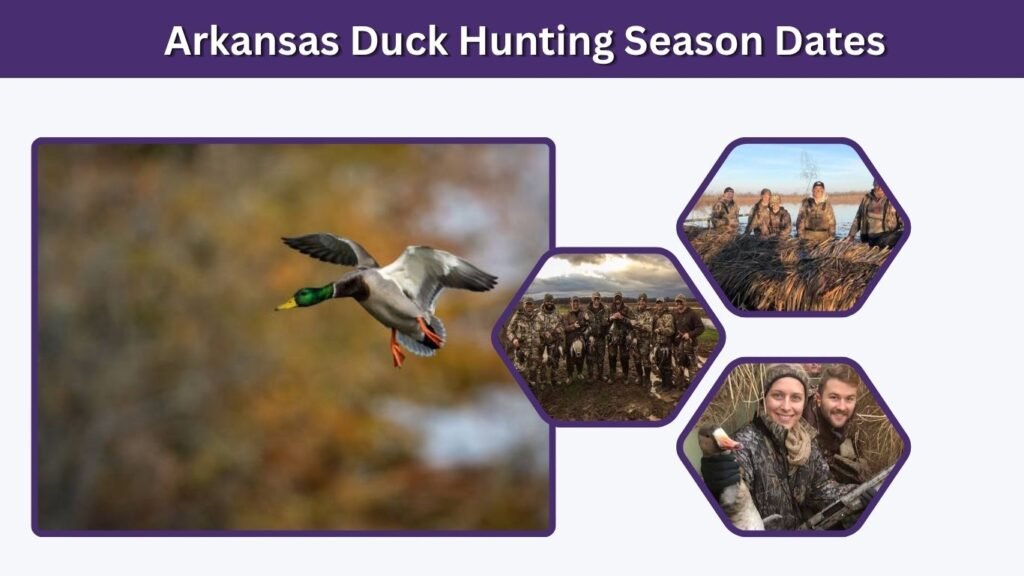
Arkansas has approved the following regular duck, coot, and merganser season segments for 2026–27:
| Season segment | Dates |
| First segment | November 21–29, 2026 |
| Second segment | December 10–23, 2026 |
| Third segment | December 26, 2026–January 31, 2027 |
The special early teal season runs September 19–27, 2026. Special youth, active-duty military, and qualified veteran hunts are scheduled for February 6–7, 2027. Regulations can change, so hunters should confirm the details with the Arkansas Game and Fish Commission before each trip.
Duck Bag Limits
The 2026–27 daily duck limit is six birds. However, species-specific limits apply within that total, including no more than:
- Four mallards, including no more than two hens
- Three pintails
- Three wood ducks
- Two canvasbacks
- Two redheads
- Two black ducks
- One scaup
- One mottled duck
The possession limit is three times the daily limit. Hunters must identify every bird before shooting because the six-duck limit does not allow six birds of every species.
Arkansas Duck Hunting License Requirements
License requirements depend on the hunter’s age, residency, hunting location, and chosen season.
Most adult duck hunters will need:
- A valid Arkansas hunting license
- Arkansas Harvest Information Program registration
- An Arkansas waterfowl stamp when applicable
- A signed federal Migratory Bird Hunting and Conservation Stamp
- Any required wildlife management area permits
Migratory bird hunters aged 16 or older must carry proof of HIP registration. Hunters should purchase licenses and complete registration before arriving at the hunting area.
Nonresident License and WMA Permits
Nonresident hunters using Arkansas wildlife management areas need more than a basic nonresident hunting license. They generally need an Arkansas waterfowl stamp, federal duck stamp, HIP registration, a WMA waterfowl permit, and the applicable general-use authorization.
For the 2026–27 season, AGFC lists a three-day nonresident WMA waterfowl permit at $40 and a consecutive 30-day permit at $200. The agency also notes that nonresidents are prohibited from hunting waterfowl at Dave Donaldson Black River WMA during the first regular-season segment, November 21–29, 2026.
Public-Land Duck Hunting in Arkansas
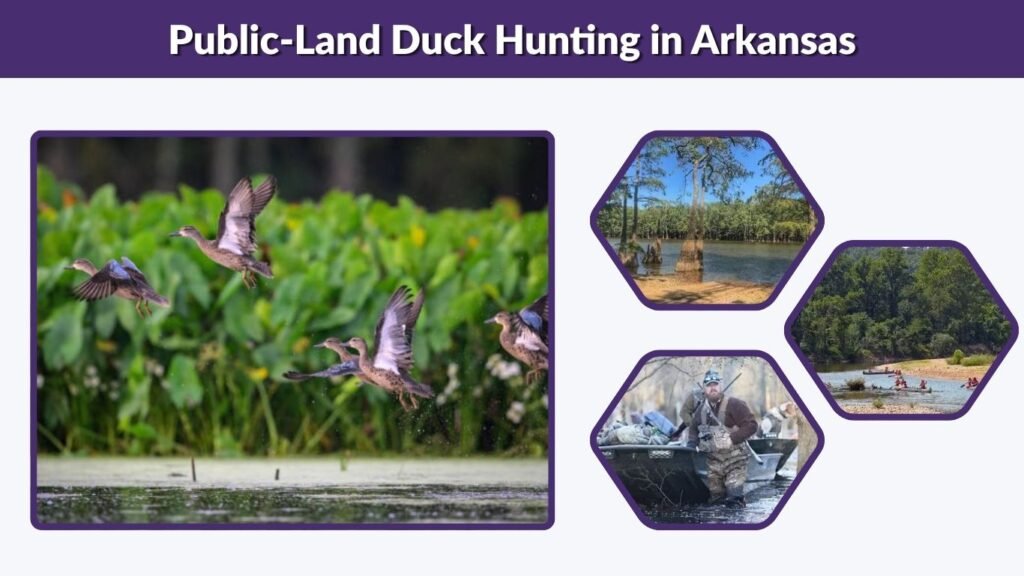
Arkansas provides public waterfowl opportunities through state wildlife management areas and federal refuges. Popular areas can become crowded, particularly on weekends, opening days, and after a strong migration.
Well-known destinations include:
- George H. Dunklin Jr. Bayou Meto WMA
- Dave Donaldson Black River WMA
- Henry Gray Hurricane Lake WMA
- Sheffield Nelson Dagmar WMA
- Cache River areas
- White River National Wildlife Refuge
Each property may have separate access rules, permit hunts, boating restrictions, designated zones, or daily closing times. Never assume that statewide regulations are the only rules that apply.
Bayou Meto WMA
Bayou Meto is closely associated with Arkansas green-timber hunting and is within reach of Stuttgart. It offers a memorable setting but can also present heavy competition, shallow obstacles, changing water levels, and difficult navigation.
For 2026–27, Arkansas is introducing additional non-motorized boat zones on parts of Bayou Meto and several other waterfowl-focused WMAs. Hunters should study the newest maps rather than relying on information from a previous season.
Public-Land Shooting and Access Hours
On many Arkansas WMAs during regular duck season, shooting begins 30 minutes before sunrise and ends at noon. Waterfowl hunters generally must leave water-inundated areas by 1 p.m.
At Bayou Meto and Dave Donaldson Black River WMAs, hunters must be off water-inundated areas by noon. Exceptions can apply on the final day and during special youth, military, and veteran hunts.
Stuttgart, Arkansas Duck Hunting
Stuttgart is widely recognized as the center of Arkansas duck-hunting culture. The surrounding landscape contains flooded rice fields, reservoirs, private clubs, timber properties, lodges, and guide operations.
A Stuttgart trip may include:
- Guided flooded-timber hunting
- Field or pit-blind hunting
- Lodging and meals
- Decoys and calling
- Transportation around the property
- Bird-cleaning services
Stuttgart is an excellent base, but hunters should not assume every package provides the same experience. Some operators hunt fields only, while others rotate between fields, reservoirs, and flooded timber according to duck movement.
Choosing Arkansas Duck Hunting Guides
A guide can be valuable for first-time visitors, nonresidents, and hunters unfamiliar with flooded timber or local navigation.
Before booking, ask:
- Is the hunt conducted on private or public land?
- Are lodging and meals included?
- What type of habitat will be hunted?
- How many hunters share the blind?
- Are decoys, boats, and retrievers provided?
- What happens if conditions are poor?
- Are deposits refundable or transferable?
- Which licenses must the guest purchase?
Avoid selecting an outfitter based only on old harvest photographs. Recent reviews, transparent pricing, clear cancellation terms, safe equipment, and honest expectations are more important.
Guided vs. Self-Guided Arkansas Duck Hunts
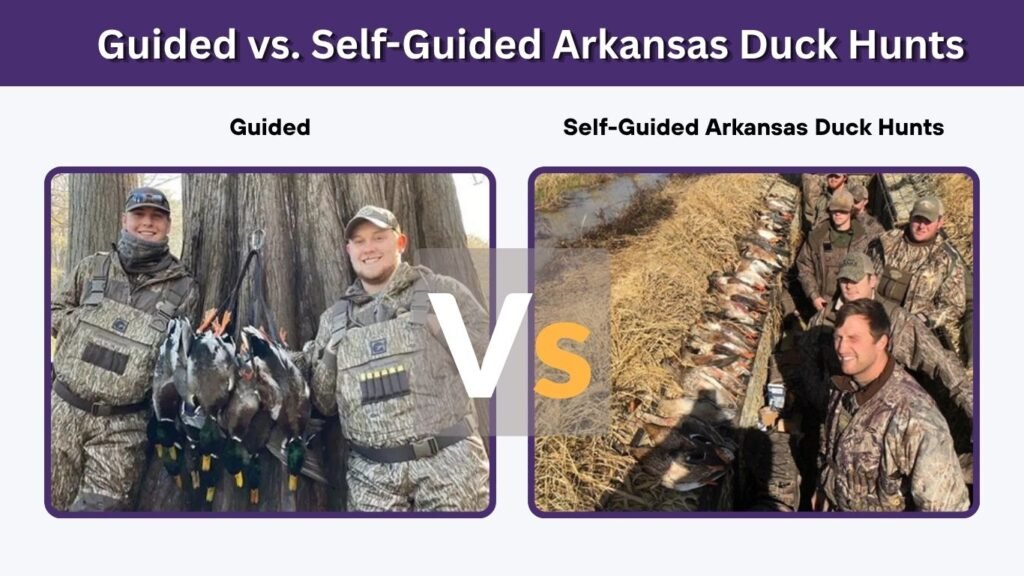
| Guided hunt | Self-guided hunt |
| Easier for first-time visitors | Greater independence |
| Access may be arranged | Hunter handles scouting |
| Equipment may be supplied | Requires personal equipment |
| Usually more expensive | Can cost less |
| Local knowledge included | More planning required |
Guided hunts reduce logistical difficulty, but they do not guarantee limits. Migration timing, temperature, wind, rainfall, hunting pressure, and habitat conditions can change daily.
Self-guided hunters must handle scouting, access planning, navigation, decoy placement, calling, retrieval, and compliance with property-specific rules.
Essential Equipment
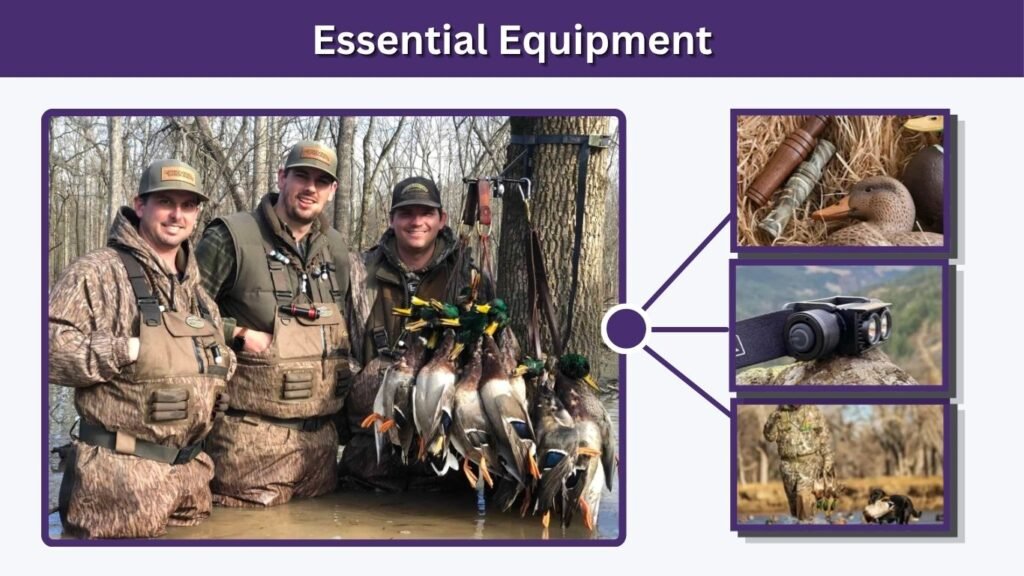
A typical Arkansas duck-hunting setup includes:
- Arkansas licenses, stamps, and permits
- Shotgun limited to three shells
- Federally approved nontoxic ammunition
- Insulated chest waders
- Waterproof clothing
- Personal flotation device when boating
- Headlamp
- Duck calls and decoys
- GPS and backup navigation tools
- Dry bag containing spare clothing
- First-aid and emergency equipment
Federally approved nontoxic shot is required for hunting ducks, geese, and mergansers throughout Arkansas.
Safety in Flooded Timber
Flooded forests can be dangerous in darkness. Submerged logs, sudden drop-offs, cold water, fast currents, fog, and hidden boat obstacles can turn a routine hunt into an emergency.
Wear a flotation device while traveling by boat, carry reliable lighting, protect your phone in a waterproof case, and share your route with someone outside the hunting party. New visitors should avoid navigating unfamiliar flooded timber before daylight without an experienced partner.
FAQs
What is the best time for duck hunting in Arkansas?
Productive hunting can occur throughout the season, but cold fronts and changing weather often move new birds into the state. Habitat conditions and hunting pressure can be more important than a particular calendar week.
Is Arkansas good for public-land duck hunting?
Yes. Arkansas has several well-known public waterfowl areas. However, popular locations can be crowded and may have special access, boating, permit, and closing-time rules.
Do nonresidents need a special Arkansas duck-hunting permit?
Nonresidents need the appropriate hunting license, stamps, HIP registration, and additional permits when hunting waterfowl on Arkansas WMAs. Requirements should be verified before the trip.
Why is Stuttgart famous for duck hunting?
Stuttgart sits near productive rice-growing country, wetlands, and flooded timber within the Mississippi Flyway. It also has a long-established network of guides, lodges, clubs, and waterfowl businesses.
Can I use lead shot for Arkansas duck hunting?
No. Hunters pursuing ducks, geese, and mergansers must use federally approved nontoxic ammunition statewide.
